

Content built to be cited, not flagged
AI writers are everywhere, and answer engines can tell. CommandSEO's enrichment editor scores your content for citability and de-slops it, cutting the AI tells and grounding every claim in a real source, so ChatGPT, Perplexity, and Google AI Overviews quote your page instead of scrolling past it.
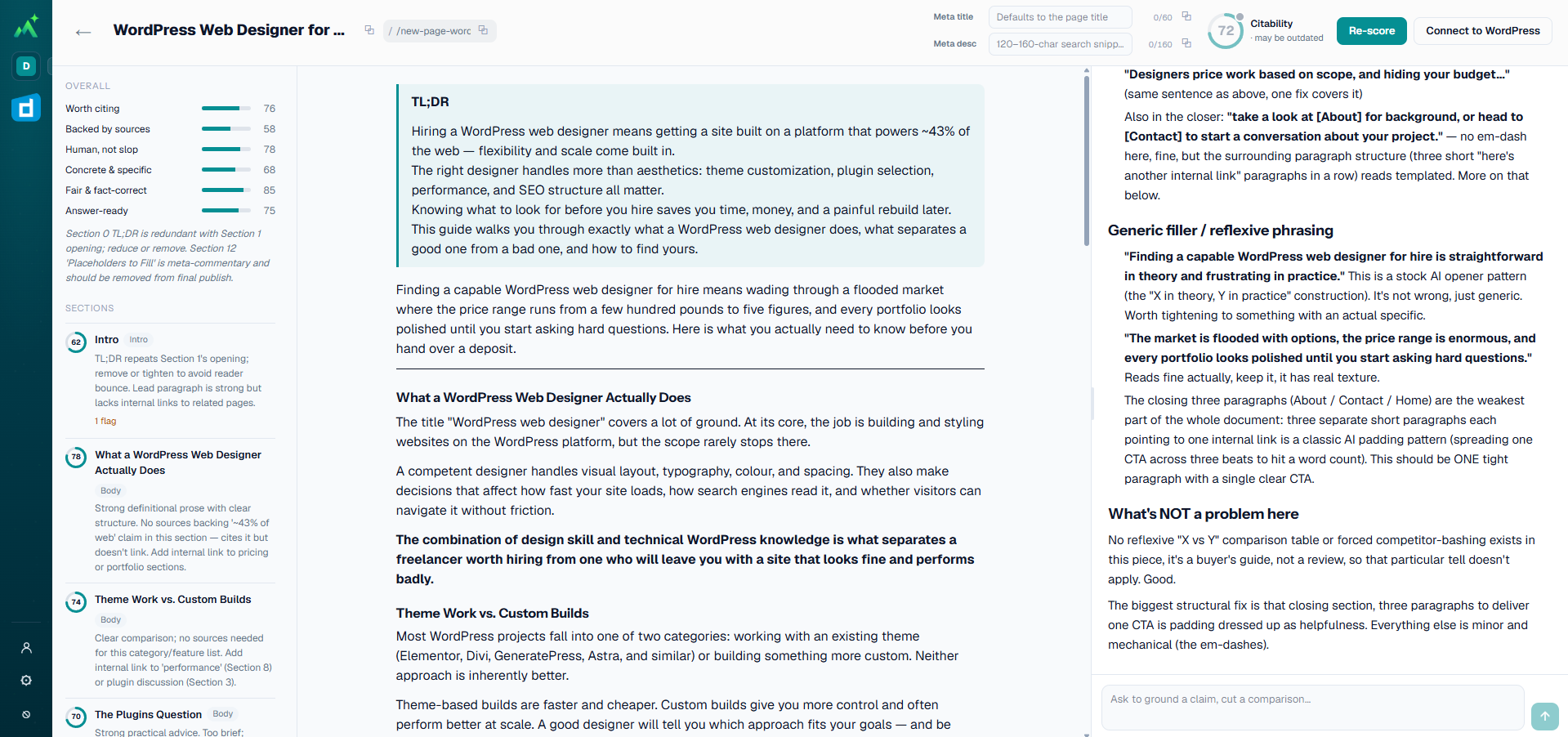
Six dimensions of citability
Enrichment doesn't score on a hunch. Every document is graded across six dimensions, and every section, each with a plain-English reason, so a low number always points at something you can fix.
Would an answer engine actually quote this, or scroll past it?
Real, named, linked sources behind the claims, not bare assertions.
No AI tells: stock openers, reflexive comparisons, em-dashes, filler.
Real numbers, names, dates, prices, not vague generalities.
Claims verifiable, competitors described honestly, no planted knocks.
A clear question, answer, and structure an engine can lift.
How anti-slop enrichment works
Score, de-slop, accept, ship. The whole thing reads like editing a document, because it is one.
Score the draft for citability
One pass grades the whole document across six dimensions and every section, with a plain-English note on what's holding each one back. Not a vibe, an auditable number you can see the reason for.
De-slop with the anti-slop chat
It reads the doc and quotes the exact fix: the stock "X in theory, Y in practice" opener, the em-dash, the claim with no source, the section that repeats another. Grounded, not generic.
Accept the tracked changes inline
Fixes land as word-level suggestions right in the document, red for what goes, green for what replaces it, accept one or all. See the projected score before you commit.
Ship it, image-rich, to WordPress
Push the de-slopped article straight to your site with its SEO meta and schema, so the version that earns citations is the one that goes live.
Why citability is its own job now
Answer engines don't quote whatever ranks. A peer-reviewed study from Princeton and Georgia Tech found that adding sources, statistics, and quotations can lift a page's visibility in AI answers by up to 40%, and the overlap between top Google results and the sources AI actually cites has fallen from about 70% to under 20%. Being ready to be cited is no longer a by-product of ranking. Enrichment is how you get there: it builds the same signals, real sources, concrete specifics, a human voice, straight into the content. Learn more about AEO and GEO, or see everything CommandSEO checks.
The AI tells it catches
These are the patterns that mark content as machine-made. Enrichment flags each one, quotes it, and fixes it.
Stock AI openers
"In today's fast-paced world…", the "straightforward in theory, frustrating in practice" construction, "when it comes to". Flagged and rewritten to lead with something concrete.
Em-dashes everywhere
The em-dash (—) is one of the strongest AI-writing tells. Enrichment flags every one and replaces it with a comma, a period, or a rephrase.
Title-Case Headings
Headings That Capitalise Every Word read as dated marketing. Rewritten to sentence case, keeping real proper nouns (WordPress, SEO) capitalised.
Unsourced claims
A statistic or assertion with no named, linked source is the #1 reason AI engines don't trust a page. Enrichment flags each one and says where a source belongs.
A redundant TL;DR
A summary that just restates the intro right below it is padding readers bounce from. Flagged to tighten or cut, judged by the page type.
Unfair competitor knocks
An unverifiable dig at a rival reads as biased slop and fails trust. Enrichment fact-checks its own flags and neutralises unfair comparisons.
Where does your website stand?
Ten quick questions to figure out which kind of SEO work will move the needle for you, foundation, content, authority, or AI visibility. No sign-up, no score, just a clear read.
Common questions
Anti-slop SEO is the practice of stripping the tells that mark content as AI-generated, ungrounded generalities, reflexive comparisons, em-dashes, stock openers, unsourced claims, and grounding it in real sources, concrete specifics, and a human point of view. The goal is content that a reader trusts and that AI answer engines are willing to cite, not content that gets flagged and skipped.
Get Search-Ready
for the AI Era.
AI still needs to find you before it can cite you. Start with the foundation.
Start free →No credit card to start.